Tunis
The North African afterlife of Iberia
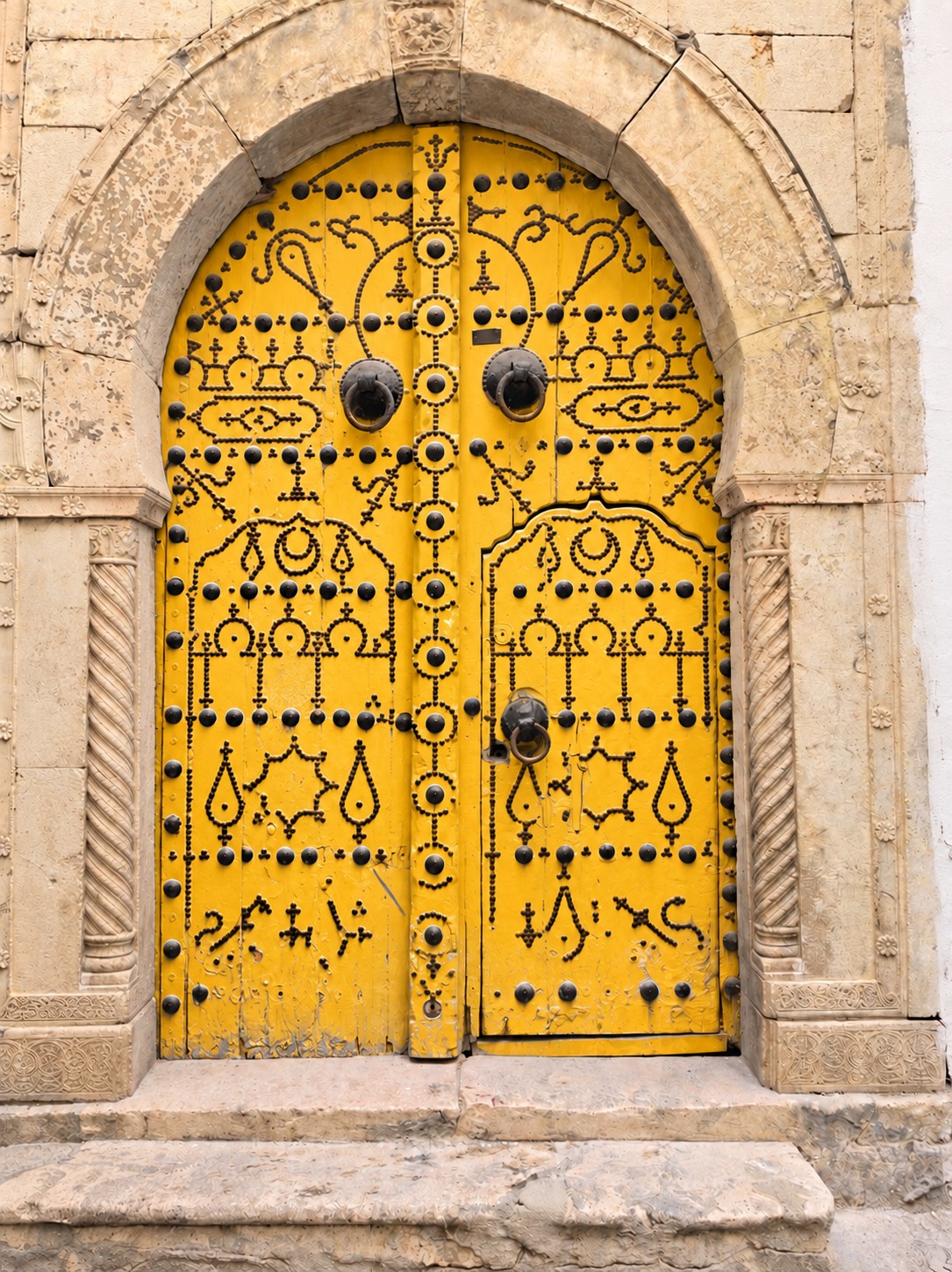
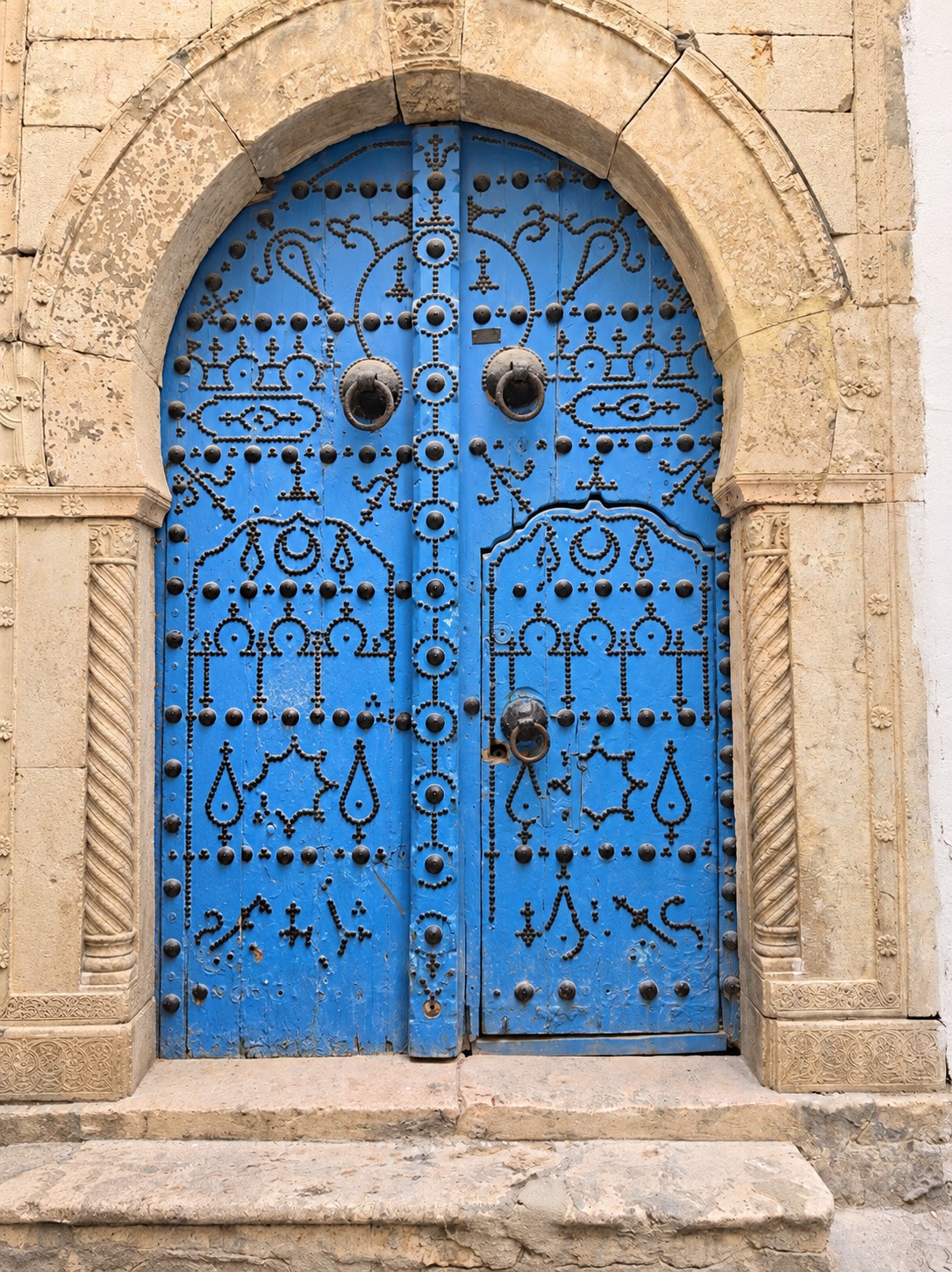
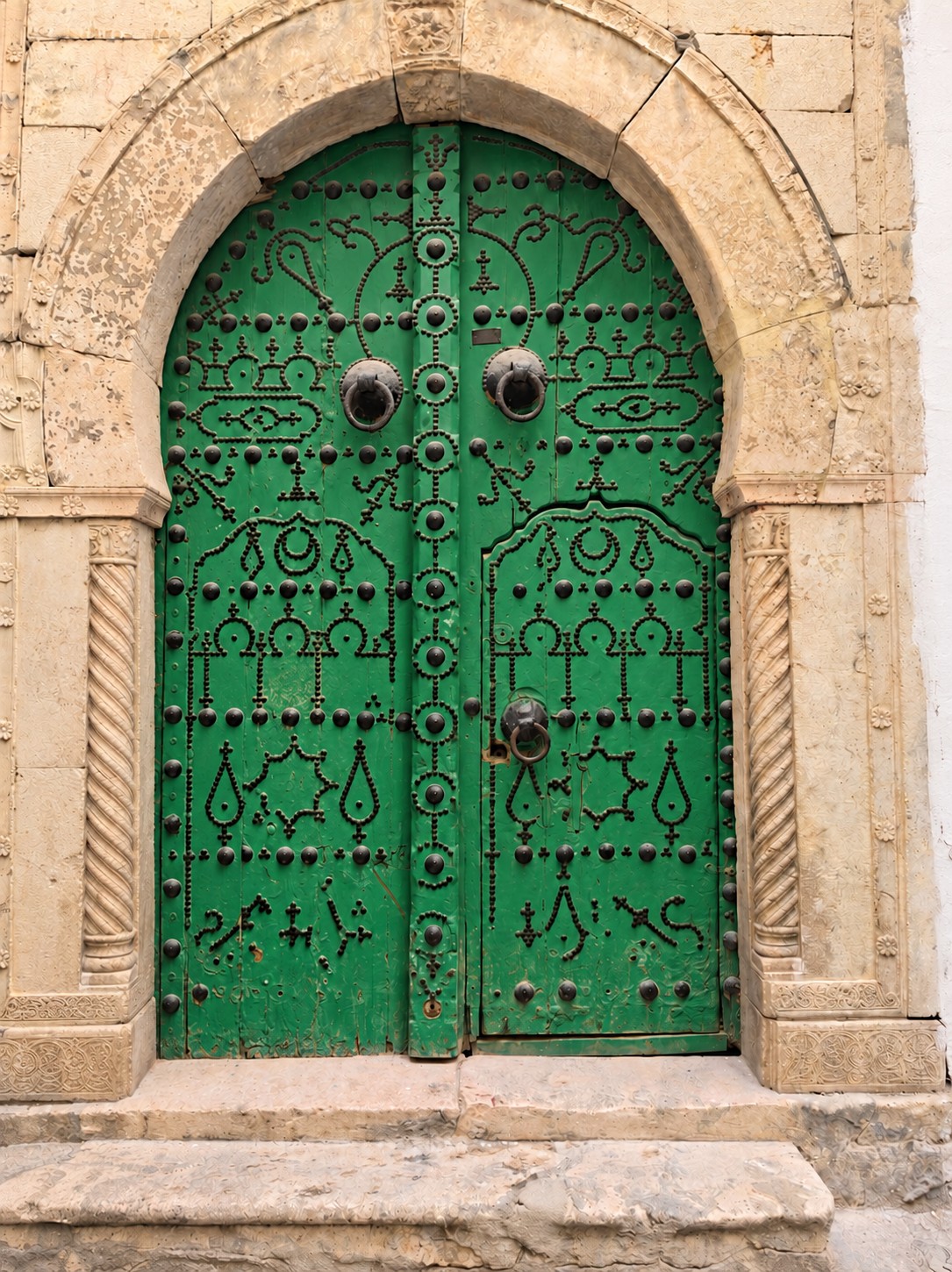
One doorway, three colors. Iconic doors in the Medina of Tunis. The colors once spoke of the households within.
Arrival
What travels with people when a homeland is left behind?
I came to Tunisia following the afterlife of Iberia in North Africa: the people who left, the communities that took root, and the knowledge, customs, and memories carried across the sea.
By this point in the journey, I had walked through Granada and Córdoba and stood at Palos de la Frontera, all in Spain. I had looked across the Strait from Gibraltar and from Tangier, Morocco. Tunisia extended the question eastward. Testour, with its Andalusian and Morisco heritage, offered a particularly vivid place to follow it.
To my pleasure and surprise, my guide began our tour with a rich explanation of Tunisian identity. My camera was not ready for the beginning. What I did capture gave the chapter an unexpected opening: the relationship between the language people speak and the histories that language alone cannot tell.
Language & identity
More than a language can tell
The guide distinguished everyday Tunisian speech from the formal Arabic learned at school. He spoke of French and Italian connections, of different accents, and of the difficulty of making himself understood elsewhere in the Arabic-speaking world.
Then he described himself through several dimensions at once: Arab, Mediterranean, and African. A shared language could connect him to others without exhausting the story of who he was.
A field conversation in Tunis, October 2026. Original recording with automatic captions; some words are mistranscribed. The accompanying prose summarizes the discussion rather than reproducing a verbatim transcript.
A language can connect people across borders. It cannot supply every person’s history. This was familiar ground for me as the author of You Are Not Your Race: the person exceeds the category. Here, the question emerged through conversation and travel. Speaking Arabic, identifying as Berber, and practicing Islam are distinct matters; none, by itself, provides a complete account of ancestry or identity.
Tunisia’s Amazigh histories and the journeys of later arrivals belong in that fuller account. Testour would bring one of those journeys into focus.
The Bardo
A traveler, a poem, a North African home
The Bardo National Museum holds one of the world’s largest collections of Roman mosaics. Housed in a former beylical palace, it brings together works from archaeological sites across Tunisia—an extraordinary record of the art, stories, and daily life of Roman Africa. A mosaic of Virgil offered another way into the story of movement.
Virgil’s Aeneid follows Aeneas after the destruction of Troy. His voyage brings him to Carthage, where he encounters Dido, herself a founder who has left another shore. The poem turns displacement, arrival, memory, and the search for a future into a Mediterranean story.
The mosaic gives that literary journey a material setting: a Roman poet represented in a North African home. Long before the Morisco migrations, stories and artistic traditions already circulated across this sea. The comparison is a thread through the chapter, not a claim that those very different journeys were the same.
Other histories in the same museum
The Jewish and Christian objects added depth to the visit. The museum’s labels placed some in the Roman period and others in twentieth-century Tunis. The collection spans distinct communities and centuries; it does not describe one unchanging religious landscape.
Keys from Naro
A booklet in lead
Ritual and craftsmanship
An inscribed instrument
Peter and John
Augustine’s Crossings
Saint Augustine (354–430), Catholic bishop, Doctor of the Church, and author of The Confessions and The City of God, was one of Christianity’s most influential thinkers. Born in present-day Algeria, he studied and taught in Carthage, in present-day Tunisia, before traveling to Rome and Milan. Following his conversion and baptism, he returned to North Africa and became Bishop of Hippo. His preaching, writings, and defense of the faith profoundly shaped the African Church and the wider Catholic tradition. His legacy offers another reminder that North Africa helped shape the intellectual and spiritual life of the Mediterranean world.
The Medina
Patterns that Traveled
Tiles had accompanied me throughout this journey—in Spain, in Morocco, and now in Tunisia. At Dar El Mnouchi, the blue, green, and gold decoration made me wonder what a pattern could tell me about the place where I found it.
Design can offer clues to a workshop, a period, or a tradition of craftsmanship. In Spain and Morocco, geometric tilework often takes the form of cut pieces fitted into a larger pattern. Painted tiles offer another way to build a repeating design. Both the technique and the pattern matter when tracing an object’s history.
Tunis has a particularly relevant story in its Qallaline workshops, active from the early seventeenth through the nineteenth century. A scholarly catalogue of their work identifies designs drawing on Maghrebi and Hafsid traditions, Renaissance Castile, the Spanish Mediterranean coast, and the Ottoman world. Tiles made in Tunis were also exported to other North African cities and Egypt.
The design found in one place may therefore preserve connections with several others. The café’s tilework invites that question; identifying its particular workshop and date would require closer study. For this journey, the documented history of Tunisian tilemaking offers another thread linking Iberia and North Africa through craft, commerce, and the movement of designs.
An echo across the Atlantic
The Caribbean offers another chapter in the history of patterned floors. In Puerto Rico, losas criollas are decorative cement tiles, also known as hydraulic tiles. The island’s historic preservation office dates their introduction to around 1900. In the Dominican Republic, hydraulic mosaics also have an established tradition of manufacture and use.
These cement tiles belong to a different technique and period from Tunis’s historic glazed ceramics. Their geometric and floral patterns nevertheless open a question to carry into the Caribbean part of this journey: how did designs travel, and how did local craftspeople make those designs their own?
A market with an island connection
Both photographs below record the same café, Dar El Mnouchi, in Souk El Leffa. Also known as the Souk of Djerbians, the market is associated with merchants from the Tunisian island of Djerba and their trade in woollen goods. That name preserves another movement of people and trade within Tunisia.
Djerba is home to an ancient Jewish community, part of Tunisia’s long Jewish history. Time prevented me from visiting the island on this trip. I hope to return and explore it on a future visit.
The souk is next to the Al-Zaytuna Mosque. Its Arabic name evokes the olive; Spanish aceituna, the word for olive, comes through Andalusian Arabic azzaytúna. Here was another crossing embedded in an ordinary word.
Testour
Iberia on another shore
In Testour, the connection I had come to follow became more explicit.
Moriscos expelled from Spain in the early seventeenth century settled in Tunisia. In Testour, those arrivals carried agricultural knowledge, building practices, food traditions, and memories into a new setting. This is the North African afterlife of Iberia at the scale of a town.
Morisco describes people of Muslim ancestry who had been baptized as Christians in Spain, and their descendants. The term should not flatten the differences in belief or experience among the people forced to leave.
The Great Mosque provides a striking architectural record. Museum With No Frontiers describes its combination of local building traditions and features recalling Iberian churches and bell towers. Its patron, Mohamed Tagharinu, had arrived from Spain in 1609.
The clock that turns the question around
The backward clock caught my attention. Local lore links its reversed direction to the longing of the Moriscos expelled from Spain: a wish to turn back time and return to the homeland left behind. Read as a story of exile and remembrance, the clock gives that longing a visible form. This is a traditional explanation, rather than an established account of the clockmaker’s intention.
The stronger evidence is the town itself: its settlement history, the mosque’s architecture, and traditions still associated with Andalusian ancestry. These give substance to the question of what people carry—and what takes a new form after arrival.
At the table
Another crossing, hiding in dinner
In Morocco, the couscous I had eaten was pale. In Tunis, it was red with tomato. The soup reminded me of Dominican food. I noticed the resemblance the night before my tour; the next day, the guide brought up the tomato’s journey.
The tomato originated in the Americas. Its presence on a Tunisian table opens another route into the chapter: ingredients moving across the Atlantic and Mediterranean, becoming ordinary parts of meals far from their origins.
The resemblance to dinner in the Dominican Republic was my own recognition. It does not establish a direct Caribbean route to Tunisia. It does remind me how much travel can disappear into something as familiar as a bowl of soup.
Looking ahead
I had followed people across the sea. In Tunisia, I found more of what traveled with them.
Language, a poem, a building practice, a recipe: each opened a different part of the story. Testour kept the chapter anchored in Iberia’s North African afterlife. Tunis widened the view around it.
The journey leaves me with a question to carry forward: how much of what feels rooted in one place began with movement from another?
I hope you will join me this winter in the Canary Islands, where we’ll explore another chapter in the movement of people, ideas, and traditions between Iberia, Africa, and the Americas.
Research Notes & Source Cautions
Field record
Fe Bencosme’s photographs, observations, and guide recording from the October 2026 visit. The recording begins after the guide’s discussion had started. Door-color associations are attributed to his explanation and are not presented as a reliable guide to present-day households. The video retains automatic captions containing transcription errors.
Historical context & reading
- Marta Domínguez Díaz, Tunisia’s Andalusians — a focused study of Andalusian identity, including Testour.
- Maria Rebecca Zarb, The Arabic Dialect of Testour (University of Vienna, 2023) — field recordings and the community’s Morisco heritage.
- Museum With No Frontiers: Great Mosque of Testour — architectural description and patronage.
- Soubeika Bahri (CUNY, 2019) — research on Tunisian Amazigh language and identity.
- Virgil, Aeneid, Book I — the Carthage episode. The literary parallel is an interpretive connection, not evidence for the later migrations.
- Benedict XVI on Augustine (9 January 2008) — birthplace, Carthage, and journeys to Italy.
Additional references
- Puerto Rico historic preservation office, Patrimonio, volume III — history of the losa criolla.
- Aguayo Tiles catalogue — Dominican hydraulic mosaic manufacture.
- FundéuRAE: aceituna / oliva — the Arabic origin of Spanish aceituna.
- Qallaline, Corpus InVisu (CNRS/INHA) — catalogue of Tunisian tile designs, their sources, and distribution.
- The Metropolitan Museum of Art: Star-Shaped Tile — Nasrid Spanish tilemaking and the movement of craftspeople and designs.
- World Jewish Congress: Community in Tunisia — Jewish communities in Djerba, Tunis, and other locations.
- American Journal of Archaeology: The Reopened Bardo National Museum — the museum’s collections and setting.
- Tunis Afrique Presse: Counter-Clockwise Clock of Testour — the tradition associating the clock with exile and longing for return.
- Souk El Leffa — the market’s association with merchants from Djerba.
Museum interpretation
Object dates, origins, and identifications follow the photographed Bardo labels. The lead booklet’s provenance is explicitly unknown. The photographed Virgil label and other museum descriptions differ on the names of the muses, so the caption identifies two muses without assigning names. Objects from distinct centuries do not establish uninterrupted local practice or a direct link to Iberian migrants.
Media & credits
Field photographs and recording by Fe Bencosme. Hero illustrations derive from her blue-door photograph: the guide and a partial foreground figure were digitally removed; the yellow and green versions were recolored with AI assistance. Obscured architectural details were reconstructed. Other photographs retain their original content; web copies are resized and compressed. Select photographs to inspect larger versions.
Scope
This chapter follows movement, settlement, and cultural transmission. It does not assign a single ancestry or religious identity to all Tunisians. The clock story is presented as local lore; the exact route of tomato introduction is not established here. Personal impressions are distinguished from historical claims.